
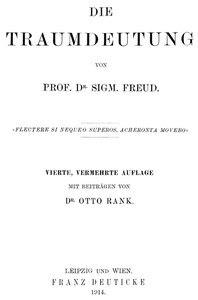
Die Traumdeutung by Sigmund Freud
Let's be clear: this isn't a novel with a plot. There's no hero's journey. The 'story' here is the story of an idea. Freud lays out his big theory: dreams are the 'royal road to the unconscious.' He argues that every dream is a disguised fulfillment of a repressed wish, often from childhood. The book is packed with examples, many from his own dreams and those of his patients. He breaks dreams down into their 'manifest content' (the weird movie you remember) and their 'latent content' (the hidden psychological meaning). Using a process he calls 'free association,' he shows how seemingly random dream elements—a train, a house, a stranger—can be traced back to real memories and desires.
Why You Should Read It
You should read this not as settled science, but as a landmark piece of intellectual history. It's the founding text of psychoanalysis. Reading Freud is like watching someone turn on a flashlight in a dark, unexplored room for the very first time. Even when you disagree with him (and you will), you can't ignore the sheer audacity of his project. He gave us a new language for talking about ourselves: the ego, the id, repression, the Oedipus complex—these ideas started here. It makes you look inward. After a few chapters, you'll catch yourself analyzing your own dreams, wondering about the 'why' behind the weird imagery. It's a book that challenges you to be a detective of your own inner life.
Final Verdict
This book is perfect for curious minds who enjoy big, provocative ideas. It's for anyone interested in psychology, philosophy, or the history of how we came to understand the human mind. If you like debating ideas over coffee, this book will give you enough material for years. It's not for readers looking for a quick, easy self-help guide. Parts of it are dense, repetitive, and his theories are definitely controversial by today's standards. But if you can approach it as a fascinating historical document—the moment we started taking our dreams seriously as windows into our deepest selves—it's a completely rewarding and mind-expanding experience. Just keep a grain of salt handy.
The copyright for this book has expired, making it public property. It serves as a testament to our shared literary heritage.
Nancy Lopez
1 year agoThe clarity of the concluding remarks is very professional.
Steven Williams
5 months agoGreat digital experience compared to other versions.
Ashley Garcia
1 year agoCompatible with my e-reader, thanks.
Kimberly Thompson
1 year agoRead this on my tablet, looks great.


Charles Thompson
1 year agoThe balance between academic rigor and readability is perfect.