
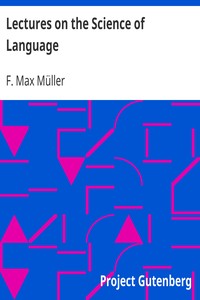
Lectures on the Science of Language by F. Max Müller
Let's be clear from the start: this isn't a novel. There's no plot in the traditional sense. Instead, the 'story' here is the unfolding of a big, bold idea. In the 1860s, Max Müller, a professor at Oxford, was asked to give a series of talks for a general audience. His mission was to explain the new 'science of language'—what we'd call linguistics today.
The Story
Müller walks his listeners through a world of discovery. He shows how comparing words across Sanskrit, Greek, Latin, and Germanic languages proved they were all part of one big family (now called Indo-European). This was a revolutionary concept. He then uses this family tree to try and reconstruct the life and myths of our ancient ancestors. The central drama of the book is Müller's passionate argument against the idea that language was a conscious human invention. He calls that notion 'absurd.' Instead, he proposes that language grew organically, almost like a law of nature, and that studying its growth is as scientific as studying geology or biology. The book is his evidence and his manifesto for this view.
Why You Should Read It
Reading Müller today is a strange and wonderful experience. You have to constantly remind yourself that he was writing before anyone had recorded a single human voice, before modern anthropology, and before many ancient scripts were deciphered. His confidence is breathtaking. He connects language to mythology, religion, and philosophy with sweeping strokes. While some of his specific theories (like the 'solar myth' idea) have been left behind, his core excitement is infectious. You feel the thrill of a new field being born. He makes you see every word as a fossil, packed with hidden history.
Final Verdict
This book is not for everyone. It's dense and its 19th-century prose requires some patience. But if you're a word nerd, a history of ideas buff, or just someone curious about how people 150 years ago tried to solve the deepest puzzles of humanity, it's a treasure. It's perfect for readers who enjoyed Simon Winchester's The Professor and the Madman or anyone who likes to see how grand intellectual battles were fought. Think of it less as a textbook of facts, and more as a time capsule from the founding moments of a science.
The copyright for this book has expired, making it public property. Distribute this work to help spread literacy.
Michelle Lopez
8 months agoThis book was worth my time since the flow of the text seems very fluid. Truly inspiring.
Noah Wilson
11 months agoClear and concise.
Amanda Allen
4 months agoAs someone who reads a lot, the atmosphere created is totally immersive. I learned so much from this.
David Young
1 year agoHonestly, the content flows smoothly from one chapter to the next. I learned so much from this.


Charles Wilson
1 year agoI started reading out of curiosity and it challenges the reader's perspective in an intellectual way. I learned so much from this.