About 354 minutes
The Shepherd of the Hills — Inside the Classic
Young Readers Enchanted Adventures
81,376 recorded words. 19 minutes difference from this book's estimate.
View Gutenberg source #4735
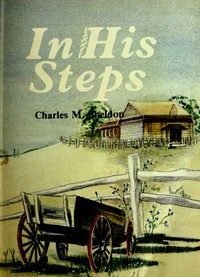
For In His Steps — Key Ideas to Explore, the stored edition analysis reports 85,652 words, 6 hr 13 min estimated reading time, and 9 detected text sections.
The text analysis averages about 16.8 words per sentence, while the detected sections provide another way to judge how the source is divided.
Project Gutenberg metadata also associates the work with “Clergy -- Fiction,” connecting these edition facts with the source record’s subject description.
Explore this collection
These alternatives are selected using recorded categories and estimated reading time.
About 354 minutes
Young Readers Enchanted Adventures
81,376 recorded words. 19 minutes difference from this book's estimate.
View Gutenberg source #4735About 401 minutes
Young Readers Enchanted Adventures
92,147 recorded words. 28 minutes difference from this book's estimate.
View Gutenberg source #6384About 335 minutes
Young Readers Enchanted Adventures
76,984 recorded words. 38 minutes difference from this book's estimate.
View Gutenberg source #4282Search stored excerpts and compare books → Choose by your preferences →
Choices use stored catalog measurements. Estimates vary with reading speed. A shared category is a catalog label, not a claim that two books have the same argument or literary quality.
Search reads excerpt text stored with this catalog and links to its associated Gutenberg record. The connection is stored in the site database; this tool does not recheck that every excerpt is word-for-word identical to that external record. Excerpt search does not cover every chapter and does not verify historical publication dates.
Catalog snapshot checked: 2026-09-25. Coverage: 100 public books, 100 available source excerpts.
Read the complete public-domain text at its original source.
Read on Project GutenbergCharles M. Sheldon opens 'In His Steps' with a scene that establishes the novel's central tension through small, precise details of voice and gesture. The Rev. Henry Maxwell, interrupted while composing a sermon on 1 Peter 2:21, answers his door to a shabbily dressed young man seeking work. The minister's initial thought—'Looks like a tramp'—and his half-finished sentence as he goes downstairs reveal a reluctance that the dialogue soon confirms. The young man's nervous shifting of his hat and the minister's curt dismissal, ending with the claim that he keeps 'only a horse and a cow and do the work myself,' create a stark contrast between the sermon's theme of following Christ's example and the minister's actual response.
The novel's first chapter juxtaposes two kinds of speech: the polished, theological language of Maxwell's sermon and the halting, deferential request of the unemployed man. The sermon, we are told, emphasizes 'the necessity of following Jesus in His sacrifice and example,' and Maxwell has written down 'Three Steps. What are they?'—a question left unanswered when the bell rings. The bell itself is described as 'one of those clock-work bells' that 'always went off as a clock might go if it tried to strike twelve all at once,' a simile that injects a note of mechanical irritation into the domestic setting. The minister's decision to answer only after the second ring, and his initial thought that the visitor 'looks like a tramp,' are rendered in plain, unadorned prose that underscores his reluctance. The young man's speech is marked by hesitations—'I didn't know but you might perhaps be able to give me a line'—and his gesture of shifting his hat 'from one hand to the other nervously' is the only physical detail Sheldon provides, making the encounter feel both brief and weighted.
Later in the excerpts, Sheldon's dialogue shifts to a different register when Virginia and Rachel discuss how to use a large inheritance. Virginia's speech is filled with the language of calculation and purpose: 'What would Jesus do with this money?' she asks, and she speaks of putting money 'into the NEWS' as 'a line with His probable action.' The phrase 'probable action' is striking—it treats Jesus' will as something that can be rationally deduced, like a business decision. Rachel's response is equally measured: 'I will gladly put my life into that kind of service. I do believe that Jesus would have me use my life in this way.' The repetition of 'I do believe' and the careful framing of personal sacrifice as 'service' reflect a deliberate, almost contractual approach to faith. Sheldon's dialogue here avoids emotional outbursts; even Rachel's tears are described as 'tears that could not be restrained,' but they follow a logical argument about 'consecrated money' and 'consecrated personal enthusiasm.'
Sheldon's descriptions of the Rectangle—the slum district—are notably sparse, relying on a few recurring nouns: 'lodging-houses,' 'refuges,' 'asylums,' 'the saloon.' Virginia's plan to 'buy up a large part of the property' and build 'wholesome lodging-houses' is presented as a straightforward solution, with no sensory detail about the existing conditions. The only vivid note comes from a reference to 'singing as that yesterday by those women,' which Virginia recalls with enthusiasm: 'Did any one ever hear such singing as that?' This single auditory detail stands out against the otherwise abstract language of reform. The saloon is described as 'legally established,' a phrase that emphasizes its institutional power rather than its physical presence. Sheldon's descriptive choices thus mirror the novel's thematic focus: the Rectangle is less a place than a problem to be solved through money and organization.
Throughout the excerpts, Sheldon uses incomplete sentences and trailing thoughts to suggest inner conflict or unspoken reservations. When Maxwell first sees the tramp, he thinks, 'I suppose I'll have to go down and—' but does not finish. Later, when Virginia speaks of her plan, she says, 'I do not know that I have yet been able to tell just what is the wisest and most effective kind of work that can be done in Raymond. But I do know this much.' The break between 'not know' and 'do know' creates a rhetorical pause that emphasizes her certainty about the money's use while leaving the method vague. Rachel's response, 'It is true. But, Virginia, what a wonderful amount of good can be done with this money!' also contains a 'but' that shifts from acknowledgment to hope. These syntactic hesitations give the dialogue a quality of earnest searching, as if the characters are working out their beliefs in real time—a technique that aligns with the novel's premise of asking 'What would Jesus do?' as a living question.
Readers attentive to Sheldon's craft will notice how the novel's moral argument is carried not by authorial commentary but by the small, telling details of how characters speak and what they leave unsaid. The minister's unfinished sentence, the tramp's nervous hat, the careful logic of Virginia's 'probable action'—these are the threads that weave the story's central question into the fabric of everyday life. To read 'In His Steps' with an eye to its diction and dialogue is to see a work that, for all its earnestness, is built on a foundation of precise, deliberate choices about how people talk when they are trying to do right.
There are mornings when I open the editorial notes on Sheldon's In His Steps and recall the heavy silence between Maxwell and that jobless man. It reminds me of another quiet reckoning — the one simmering inside The Courtship of Susan Bell — Context and Discussion. Both books ask, without raising their voices, what we owe the stranger whose need unsettles us.
Use these questions to collect your thoughts before moving on.